The whole story, in one picture
From documents to decisions
The anatomy of strategic drift, the assurance cycle, and what a controlled validation run on a synthetic company showed — accurate, cited, low cost.
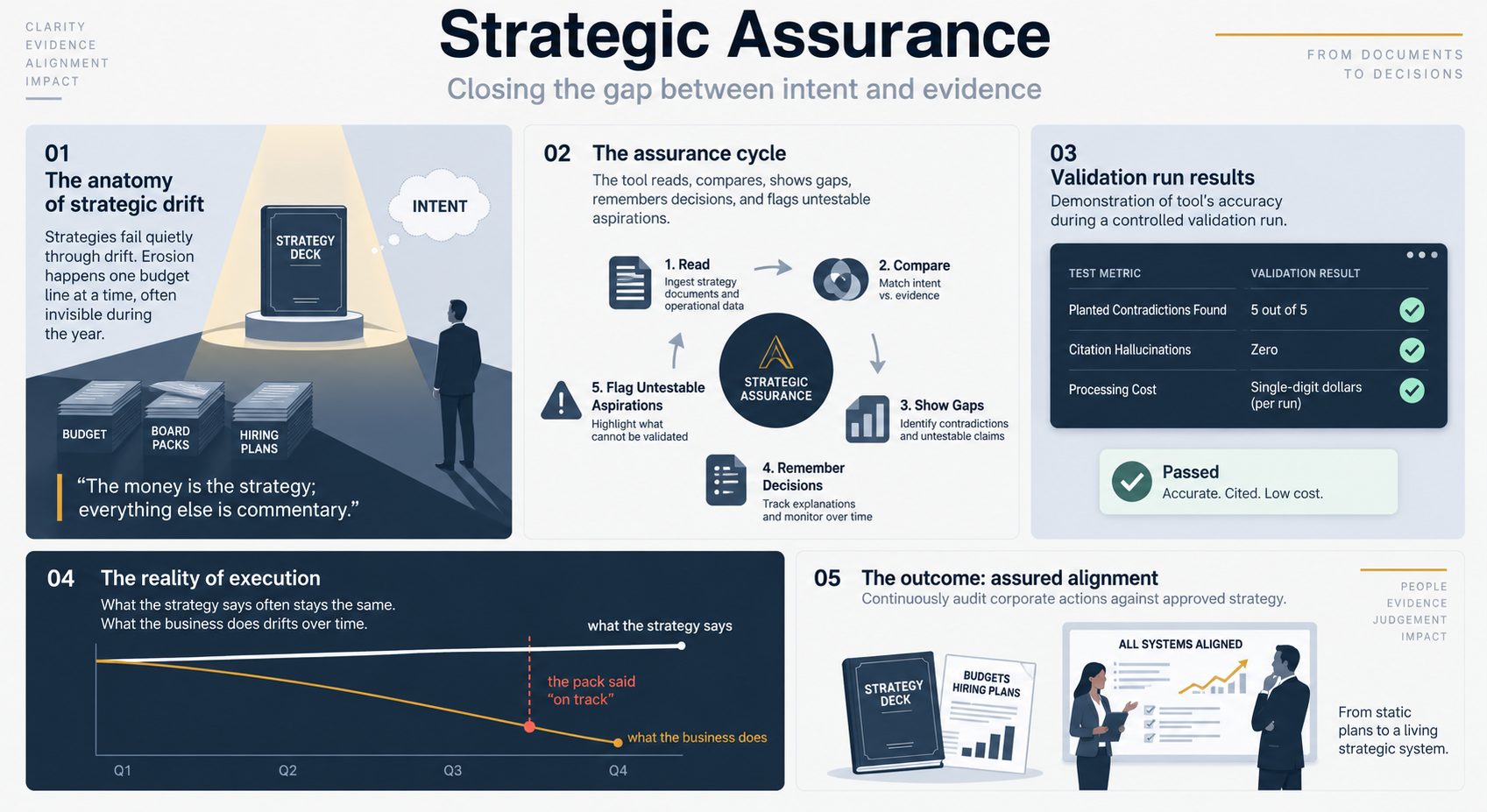
Strategic assurance
Most boards cannot answer that with evidence. Yet the evidence exists — in the board pack, the budget, the hiring plan and the pipeline. Nobody reads it against the plan.
Insight 01
Not usually because they were wrong. Because they were never built to be checked — and so nobody noticed when the organisation stopped following them.
“Quality is in our DNA” cannot be contradicted by any observation, which means it cannot guide any decision either. A strategy nobody could disagree with allocates nothing.
The money is the strategy. If the deck says one thing and the budget, hiring and capex say another, the organisation is executing the budget — every time.
For most strategic claims there is no stated evidence that would show they are not being followed. What cannot be tested cannot be governed.
Every deviation arrives with a reasonable explanation. Each one is accepted. Nobody totals them — so the board discovers the gap at the worst possible moment, in the numbers.
“Growth is our priority.”
Beats nothing, loses to nothing, decides nothing. It will survive every budget round untouched — because it constrains none of them.“Margin before growth: no deal below 12% contribution without a board exception.”
Ranked, numbered, with a named escape valve. Two observations could contradict it — and both are in documents the business already produces.Before strategy can become executable, it has to become explicit. Before it can become explicit, it has to become testable.
Insight 02
Adherence is a governance habit, not a heroic effort. Four practices do most of the work — and none of them requires new reporting.
For each material priority, name the document that would show it is not being followed. If no such document could exist, you have found an aspiration wearing a strategy’s clothes.
Not just against last year. Quarterly, ask of the pack, the budget and the hiring plan: which strategic claim does this support, and which does it contradict?
Deviations are legitimate; unrecorded ones are how drift compounds. An exception with an owner and an end date is governance. An exception that quietly renews itself is a new strategy nobody approved.
“Timing” explained the miss in Q2. Did it hold in Q3? Innocent explanations deserve to be believed once — and checked afterwards. Recurrence is the signal.
Insight 03
Strategies rarely fail by being wrong on day one. They fail by staying unchanged after the world moved. Retiring one on evidence is a governance success, not an admission of failure.
Every plan rests on beliefs about demand, costs, competitors and people. State them, attach a trigger to each, and treat a fired trigger as an obligation to re-decide — not an awkward slide.
A charter with many exceptions is a charter nobody believes. If the organisation routinely needs permission to ignore the strategy, the strategy is already dead — it just has not been told.
A strategy that cannot change absorbs contradictions one at a time until the words and the behaviour part company entirely. At that point the document protects nobody — least of all the board that approved it.
An organisation that can see where it is contradicting its own strategy can choose: correct the behaviour, or change the strategy. Either is fine. Not knowing is what costs.
What we are building
A tool that reads the documents a business already produces — board packs, budgets, org charts, pipeline — against the strategy its board approved, and surfaces where the two disagree. Quietly, privately, with the evidence attached.
Nothing is asserted without a verbatim quote from your own documents — and every report ends with a register of the exact document versions it was built on, integrity-checked, with any issued copy verifiable as authentic or altered.
The machine proposes; a named person decides. Innocent explanations are considered on the page, disputes are recorded, and nothing reaches a board without human judgement.
Runs privately, single-tenant. Sensitive names and figures are protected before any model sees them, and nothing is used to train anything. Confidentiality is the architecture, not a policy.
The second quarter is worth more than the first: cleared findings, persisting ones, exceptions approaching expiry, and whether last quarter’s explanation survived contact with this quarter’s evidence.
Sometimes the first finding is that the strategy cannot yet be tested at all. That is not a failure — it is the most useful thing a leadership team can learn early, and it is where the work begins.
The first step beyond assurance is live: from the strategy and the evidence, the tool derives next moves — cuts, investments, partnership shapes — always as competing options with consequences, each awaiting a named person's decision. Where the rest is heading, stated honestly as direction: helping leadership state its strategy as real, testable choices — drafted as options, never made for you — and a working surface between the quarterly reviews: what needs acting on this week, and whether each commitment is progressing on evidence or on assertion.
The whole story, in one picture
The anatomy of strategic drift, the assurance cycle, and what a controlled validation run on a synthetic company showed — accurate, cited, low cost.
Watch it explained
How strategies drift without anyone noticing, what strategic assurance does about it, and what the tool actually produces — walked through end to end.
Plays in YouTube's privacy-enhanced player. Still have time afterwards? The Strategy Steward, eleven minutes, takes it further.
The tool itself: documents in, claims confirmed, contradictions out with the passages they came from.
The Strategy Steward: everything the explainer and the demo cover, taken further. Watch it after the explainer if you have the time; it stands on its own if you do not.
Who it serves
Not a dashboard for the executive team to mark its own homework. Assurance for those who approved the plan and need to know whether it is being followed.
Will it work for you?
Twelve questions about one business you know well, scored in your browser — nothing is stored unless you choose to send it. If the strategy is testable and the evidence exists, a review has something real to check. If not, the result tells you exactly why, and what fixes it. Either way, you learn something before you ever talk to us.
Start the readiness checkWe need your help
That is the question we cannot answer from inside our own product. So we are asking the people who would have to live with the answer — chairs, investors, operating partners, chief executives and the advisers around them.
The survey asks where the idea breaks rather than whether it sounds clever, and the awkward answers are the useful ones. It is completely anonymous — no name, no email, no IP address — and nothing reaches us until you press submit. It is separate from the readiness check, and nothing connects the two.
It is a genuine research instrument rather than a lead form, and what comes back decides what gets built next. If you would rather read first, the project overview inside is a two-minute read.
We are working with a small number of boards, investors and advisers while the tool is refined. If the question at the top of this page is one you cannot currently answer, we would like to hear from you.
Not sure it fits? Take the readiness check first.